Fortress, Crossroads, Survivor: The Untold History of Benkovac That Every History Buff Should Know
America has a complicated relationship with old things. A building from 1850 is considered ancient. A town founded before the Civil War gets a historical marker and a gift shop. So imagine what it feels like to stand in front of the Benkovac Fortress — a medieval stronghold rising from the flat Ravni Kotari plain in inland Dalmatia — and realize that the ground beneath your feet has been continuously shaped by human hands for somewhere in the neighborhood of three thousand years.
Benkovac doesn't show up in the highlight reels. It's not on the standard Croatian itinerary. But for anyone genuinely interested in European history — not the sanitized, tourist-brochure version, but the complicated, layered, sometimes brutal reality of how cultures collide and survive — this small Dalmatian town is as compelling as anywhere on the continent.
Deep Roots: Before the Town Had a Name
The story starts long before Benkovac existed as a defined settlement. The Ravni Kotari — the wide, fertile plain that stretches between the Dalmatian coast and the Dinaric Alps — was inhabited by the Liburnians, an ancient Illyrian people whose seafaring reputation impressed even the Romans. Archaeological sites scattered across the region, including the significant Illyrian hillforts known as gradinas, point to a sophisticated pre-Roman civilization that understood this landscape intimately.
When Rome absorbed Dalmatia in the first century BCE, the region became part of the province they called Illyricum, later reorganized into Dalmatia proper. The Roman footprint in the wider area is substantial — the nearby ruins at Asseria (modern-day Podgrađe, just outside Benkovac) represent one of the more undervisited Roman archaeological sites in the entire Adriatic region. Asseria was a significant Roman municipium, complete with city walls, a forum, and funerary monuments. Walking those ruins today, mostly in peaceful obscurity, feels like a different kind of time travel than the crowded experience at Diocletian's Palace in Split.
The Medieval Pivot: Fortresses and Shifting Powers
Fast-forward through the early medieval period — the migrations, the Byzantine influence, the gradual emergence of Croatian identity — and you arrive at the era that gave Benkovac its most visible landmark: the fortress.
The Benkovac Fortress, known locally as Kaštel Benković (the town's name itself derives from the noble Benković family), was constructed in the medieval period and subsequently expanded and modified across the centuries. Its story is inseparable from the broader story of Dalmatia as a contested borderland — a place where the ambitions of Venice, the Ottoman Empire, and various Croatian and Hungarian powers ground against each other for hundreds of years.
The Ottomans reached this region in the 16th century, and the impact was seismic. Towns were abandoned. Populations fled toward the coast or deeper into Venetian-controlled territory. The demographic and cultural landscape of the Ravni Kotari was transformed, with waves of new settlers — many of them Vlach and Serb Orthodox communities fleeing Ottoman expansion from the east — reshaping the ethnic and religious composition of the region. This history is essential context for understanding the complexity of the area's identity, including tensions that would resurface, tragically, in the 20th century.
Venice eventually pushed the Ottomans back through the Morean War and the subsequent Great Turkish War in the late 17th century, and Benkovac returned to Venetian control. The fortress was reinforced. The town began to rebuild.
The Sounds of Survival: Music as Historical Memory
This is where the story gets personal in a way that goes beyond dates and battles — and it's why Radio Benkovac exists in the first place.
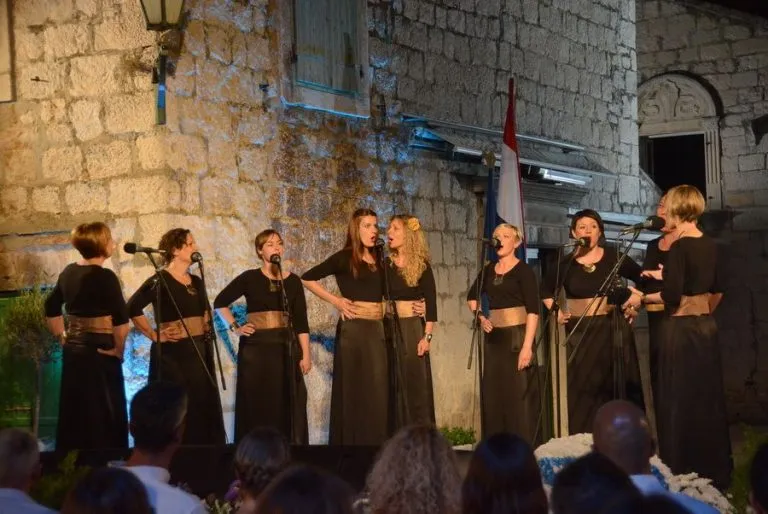
One of the most remarkable aspects of Dalmatian culture is the way music has functioned not just as entertainment but as a vessel for historical memory. The tradition of klapa — unaccompanied polyphonic singing that UNESCO recognized as an intangible cultural heritage in 2012 — carries centuries of lived experience in its harmonies. Songs about the sea, about departure and return, about love and loss, encode the emotional history of a people who spent generations navigating uncertainty.
In the Benkovac region specifically, the musical traditions reflect that layered history. The meeting of different cultural influences — Venetian, Ottoman-adjacent, Orthodox, Catholic — produced a sonic landscape that's distinct from the more famous coastal klapa traditions. It's rougher in places, more melancholic in others, and shot through with a kind of stoic beauty that makes sense when you understand what the land has been through.
For American listeners discovering this music through platforms like Radio Benkovac, there's often a moment of unexpected recognition — not because the music sounds familiar, but because the emotional register does. Resilience expressed through song is a universal language.
The 20th Century: Trauma and Reconstruction
No honest account of Benkovac's history can skip the 20th century, and this part requires care.
The region suffered enormously during World War II, caught between occupation, resistance movements, and brutal reprisals. Then, in the early 1990s, as Yugoslavia disintegrated, the Benkovac area became part of the self-declared Republic of Serbian Krajina — a breakaway entity that placed it outside Croatian government control from 1991 until Operation Storm in August 1995, when Croatian forces reintegrated the region. The war left deep scars: displacement, destruction, and demographic shifts whose effects are still being processed.
This isn't ancient history. People alive today remember it. And yet Benkovac continues — market days, football matches, festivals, the ordinary rhythms of a community rebuilding its sense of itself. There's something genuinely instructive in that persistence, something that resonates with American ideals about communities that refuse to be defined entirely by their worst moments.
Why Americans Should Pay Attention
Here's the honest answer: because understanding places like Benkovac makes you better at understanding the world.
Americans tend to engage with European history through its grandest monuments — the Colosseum, Versailles, the Acropolis. These are extraordinary, but they tell a particular kind of story, one about power at its most concentrated and confident. Benkovac tells a different kind of story: about what happens at the edges of empires, about how ordinary people maintain identity under pressure, about the way culture — music, food, language, memory — becomes a form of resistance when everything else is uncertain.
The Illyrians built their hillforts here. The Romans built their forums. The medieval Croatians built their fortress. The Venetians reinforced it. Communities of different faiths and origins found ways to coexist, and sometimes failed to, and kept going anyway. That's a history worth knowing.
And if you want to hear what that history sounds like — the harmonies that carried it, the rhythms that kept it alive — Radio Benkovac is a pretty good place to start.