Slow Down and Log In: Why Remote Workers Are Quietly Falling for a Little Town Called Benkovac
There's a particular kind of exhaustion that sets in when you've been working remotely from the same rotation of "digital nomad hotspots" — the co-working cafés in Medellín, the beachside apartments in Chiang Mai, the increasingly crowded Airbnbs of Porto. Everything starts to look the same. The Wi-Fi passwords blend together. The Instagram backdrops feel rehearsed.
That's exactly the feeling that pushed Sarah Kowalski, a 34-year-old UX designer from Austin, Texas, to open up a map of Croatia and start scrolling past the obvious choices. She skipped Dubrovnik. She skipped Split. She kept going until she landed on a name she'd never heard before: Benkovac.
"I honestly typed it into Google just to see if it was real," she laughs. "And then I booked a flight three weeks later."
That was two years ago. She hasn't left.
What Benkovac Actually Looks Like (Spoiler: It's Not What You Expect)
Situated in the Ravni Kotari region of inland Dalmatia — a wide, fertile plain that unfolds between the coast and the Dinaric mountains — Benkovac sits about 25 miles northeast of Zadar. It's not a postcard town in the way Dubrovnik is. There are no cruise ships docking here. No souvenir shops selling refrigerator magnets shaped like the Adriatic coast.
What there is: a genuine, working Croatian town with a covered market, a medieval fortress, a handful of excellent konobas (traditional taverns), and a pace of life that feels almost radical by American standards.
"People actually say hello to you on the street," says Marcus Webb, a 41-year-old freelance software developer from Denver who relocated here 18 months ago with his partner. "Not in a performative, small-town-theater kind of way. Just genuinely. It took some getting used to."
The cost of living is a major draw. A one-bedroom apartment in Benkovac typically rents for somewhere between 300 and 450 euros per month — a fraction of what you'd pay in Zagreb, let alone anywhere in Western Europe. A full meal at a local restaurant, including a glass of local wine, rarely tops 10 euros. Marcus estimates he's spending about 60 percent less than he was in Colorado while working the same client load.
The Practical Stuff: Internet, Visas, and Getting Around
Here's where things get real, because no amount of charm makes up for a connection that drops mid-Zoom call.
The good news: Croatia's internet infrastructure has improved dramatically over the past decade, and Benkovac is no exception. Most rental apartments come equipped with solid broadband, and local SIM cards from providers like A1 or Telemach offer reliable 4G coverage throughout the region. Several of the town's cafés have started positioning themselves — quietly, without any obnoxious neon "co-working" signage — as reliable spots to sit and work for a few hours.
On the visa front, Croatia joined the Schengen Area in January 2023, which simplifies travel within Europe but also means Americans are limited to 90 days out of every 180 under standard tourist rules. The workaround that many nomads are using is Croatia's Digital Nomad Visa, introduced in 2021, which allows non-EU citizens to live and work in the country for up to a year (renewable). You'll need to show proof of remote employment or freelance income — roughly $2,500 per month is the general threshold — and the application process, while bureaucratic, is manageable.
Getting around the region is easiest by car. Zadar is a smooth 30-minute drive, which means access to an international airport, a proper hospital, a broader range of shopping, and, yes, the coast. Many Benkovac-based nomads describe this setup as the best of both worlds: the quiet and affordability of inland living with the beach genuinely close enough for a Tuesday afternoon swim.
The Culture Piece Nobody Talks About
What separates Benkovac from other "undiscovered" European towns that end up on nomad listicles is something harder to quantify. This is a community with a deep, layered sense of identity. The Ravni Kotari region has been continuously inhabited for thousands of years. The local dialect carries its own rhythms. The food — lamb slow-roasted under a peka, fresh sheep's cheese from nearby farms, figs that actually taste like figs — is rooted in land and tradition rather than trend.
For Americans used to consuming culture as a kind of backdrop, this can be disorienting in the best possible way.
"I started actually caring about where my food came from," says Sarah. "Not in a Brooklyn-farmer's-market way. Just because the guy selling me cheese at the market also made it. That changes your relationship to a place."
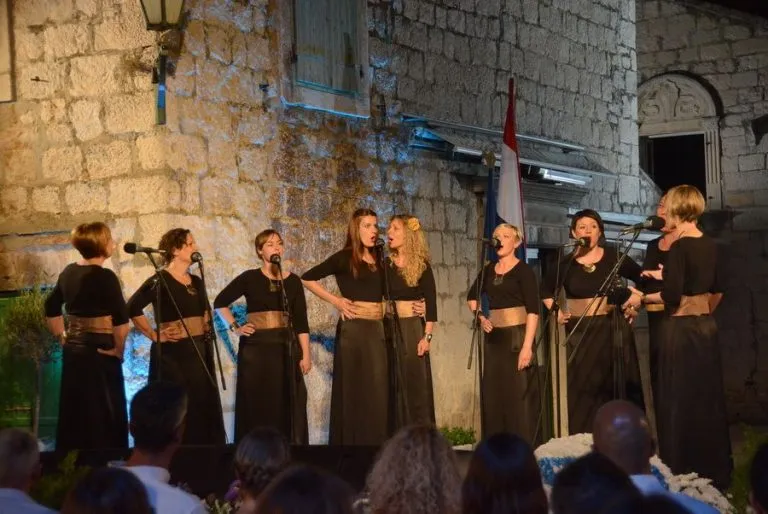
There's also music. Radio Benkovac has long been the sonic heartbeat of this region — the station that plays the klapa harmonies, the local news, the mix of traditional and contemporary sounds that keep the community tethered to itself. For newcomers, tuning in is one of the fastest ways to start feeling less like a tourist and more like a resident.
A Few Tips If You're Thinking About It
If Benkovac is starting to sound like somewhere you want to point your laptop, here's what the people already there want you to know:
Learn at least basic Croatian. Google Translate will get you through transactions, but a few phrases go a long way toward being welcomed rather than merely tolerated. Locals notice and appreciate the effort.
Don't expect everything to be optimized for you. This isn't a nomad hub with curated onboarding experiences. That's the point. You'll figure things out, and the process of figuring them out is part of what makes it meaningful.
Come in shoulder season. Late spring (May–June) and early fall (September–October) offer the best combination of weather, lower prices, and a town that isn't navigating summer tourist overflow from the coast.
Budget for a car. Public transportation exists but is limited. A used car or a long-term rental opens the region up considerably.
Benkovac isn't going to be the right fit for everyone. If you need a buzzing social scene, a full roster of networking events, and a flat white on every corner, this probably isn't your place. But if you've been looking for somewhere that feels real — somewhere with history in the stone and flavor in the food and neighbors who actually know your name — it might be exactly what you've been scrolling past.
Sarah Kowalski, for her part, has no plans to leave. "I keep waiting for it to stop feeling special," she says. "It hasn't."