Beyond Broadway of Country: How Dalmatian Stone Walls Are Unlocking Nashville Songwriters' Best Work
There's a particular kind of creative fatigue that sets in when you've spent too long inside the Nashville machine. You know the format. Verse, pre-chorus, chorus, bridge — timed to radio specifications, scrubbed clean for playlist algorithms, polished until any rough edge that might have made it interesting has been buffed smooth. It's efficient. It pays. And for a lot of songwriters, it eventually stops feeling like music.
That's the moment a surprising number of them are getting on a plane to Croatia.
Benkovac isn't a place you stumble into. It sits in the Ravni Kotari plain of Dalmatia, a few kilometers inland from the Adriatic coast, surrounded by karst limestone, olive groves, and the kind of quiet that doesn't have a setting on any sound machine app. It's a town built on layers — Illyrian, Roman, Ottoman, Venetian — where the walls themselves seem to carry narrative weight. And for songwriters who've grown tired of chasing trends, that weight turns out to be exactly what they were missing.
What Nashville Gets Right (And What It Gets Stuck On)
To be fair to Nashville, the city remains one of the most concentrated pockets of songwriting talent on the planet. The craft culture there is genuinely serious — co-writing sessions, pitch meetings, publisher relationships, the whole infrastructure of professional songwriting is more developed there than almost anywhere else in the world.
But infrastructure has a way of becoming its own kind of cage. When every song is written with a specific artist's brand in mind, when every lyric gets filtered through what worked last quarter on streaming platforms, the creative process starts to feel less like art and more like product development. Plenty of writers can sustain that indefinitely. Others hit a wall.
"You start second-guessing instincts you used to trust," one Nashville-based writer who spent three weeks in Benkovac last spring told us. "You catch yourself writing for a committee that isn't even in the room."
Benkovac doesn't have a committee. It barely has a music industry infrastructure at all — which, paradoxically, is the point.
The Oldest Stories in the Room
What Benkovac does have is a storytelling tradition that predates the concept of a music market by several centuries. The region has been shaped by the South Slavic oral epic tradition, by the ganga singing style of the Dalmatian hinterland, by the kind of folk music that was never written down because it lived in people's mouths and memories instead.
For American songwriters trained on the idea that a great song tells a specific truth in a specific voice, encountering that tradition is a bit of a gut-check. These aren't polished performances. They're not optimized for anything. They're just human beings processing life — loss, work, love, land — through sound. The emotional directness of it tends to hit hard.
Several writers have described sitting in on informal gatherings in the region and feeling something shift in how they thought about their own work. Not because they're trying to write Croatian folk music — they're not — but because the exposure recalibrates something. It reminds you what a song is actually for.
The Landscape Does Half the Work
Benkovac's physical environment plays its own role in the creative reset. The Ravni Kotari is flat and wide and ancient-feeling in a way that the rolling green hills of Tennessee simply aren't. The light is different. The silence is different — deeper, somehow, with the particular quality of places where very little is trying to compete for your attention.
Songwriters talk about walking the surrounding countryside and finding that lines come to them differently than they do back home. Less constructed, more discovered. The landscape has a way of making the internal noise quieter, which turns out to be the precondition a lot of writers need to hear what they're actually trying to say.
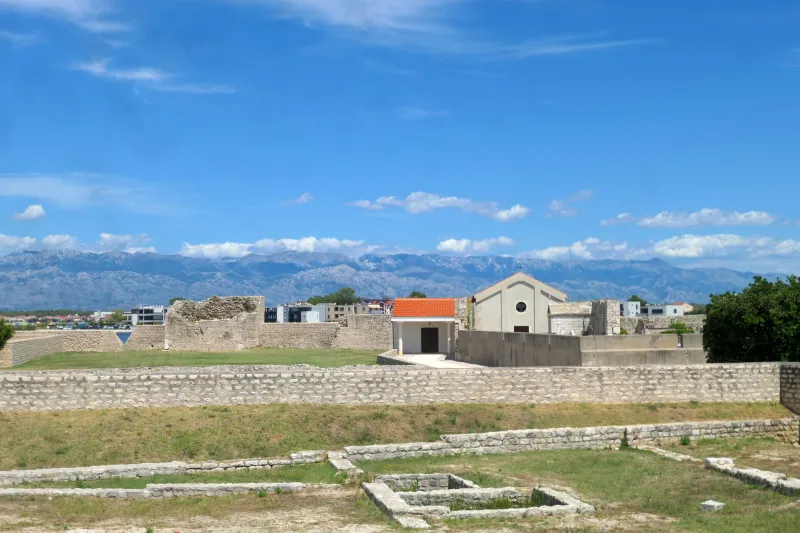
The town's fortress — the Venetian-era citadel that still anchors the town's skyline — has become something of an unlikely muse for visiting artists. There's something about writing in sight of walls that have survived wars, occupations, and centuries of ordinary human life that puts your own creative struggles in a different perspective.
Collaboration Without the Stakes
One underrated aspect of the Benkovac experience for visiting songwriters is what happens when they connect with local musicians. The Dalmatian music scene is genuinely collaborative by tradition — music here has always been a communal act, not a competitive one — and that ethos tends to rub off.
Writing with Croatian musicians who have no stake in your career, no publishing deal to protect, no agenda beyond the music itself, turns out to be a remarkably freeing experience. The co-write becomes about the song, full stop. No one's angling for a cut on a major-label release. No one's steering the melody toward a specific artist's lane.
"It's the first time in years I finished a writing session and didn't immediately wonder whether it was pitchable," another writer described. "I just thought: that's a good song. That felt like enough."
Bringing It Back Home
The interesting question, of course, is what happens when these writers return to Nashville. Does the Benkovac reset actually translate into better work within the commercial system, or does it just produce a batch of songs that are too raw, too personal, too uncategorizable to fit anywhere?
The answer seems to be: both, and that's okay. Some of what gets written in Dalmatia stays there, at least for a while — songs that need more time before they're ready to be pitched or recorded. But writers consistently report that the experience recalibrates their entire approach, including the work they do back in the professional grind.
The internal editor that had been running too loud gets turned down a notch. The instinct to self-censor before a line is even finished weakens. The muscle for writing toward genuine emotion rather than marketable emotion gets exercised again.
Why This Matters for American Music
At Radio Benkovac, we've watched this slow migration of Nashville talent with a particular kind of pride — not because we're trying to poach anyone from Tennessee, but because it speaks to something real about what this region has to offer the wider world.
Benkovac has never been in the business of manufacturing culture. It just has culture — deep, unglamorous, human-scale culture that's been accumulating here for millennia. When American songwriters show up looking for something they've lost, they tend to find it, not because anyone engineered it that way, but because authenticity is hard to fake and impossible to manufacture, and this place has never had to try.
Nashville will always be Nashville. The craft, the community, the infrastructure — none of that goes away. But sometimes the best thing a great songwriter can do for their Nashville career is leave Nashville for a while and go find out what they actually have to say.
Turns out a small Croatian town in the Dalmatian hinterland is pretty good at helping with that.